
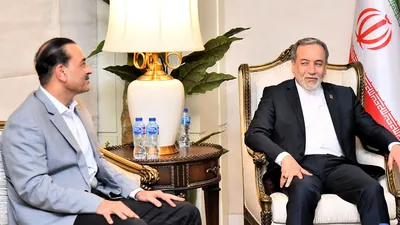
Credit Hindustan Times
ISLAMABAD (April 26, 2026) — In a whirlwind turn of diplomacy, Iranian Foreign Minister Abbas Araghchi has returned to the Pakistani capital today, carrying what Tehran describes as a “workable framework” to permanently end the eight-week conflict with the United States. The sudden return follows a weekend of high-stakes confusion after U.S. President Donald Trump abruptly canceled a planned trip for his senior envoys.
The Return to Islamabad
Araghchi, who had briefly departed for Oman and Russia after a “fruitful” Saturday session with Pakistani Prime Minister Shehbaz Sharif and Army Chief General Asim Munir, touched back down in Islamabad on Sunday. His return signals an urgent attempt by international mediators to keep peace talks on life support after the White House signaled a cooling of interest.
“We have shared Iran’s position concerning a workable framework to permanently end the war,” Araghchi posted on X, while notably adding a jab at Washington: “Have yet to see if the U.S. is truly serious about diplomacy.”
Trump’s Tactical Pivot
The diplomatic momentum hit a major speed bump Saturday when President Trump announced he had ordered envoys Jared Kushner and Steve Witkoff to stay home. Speaking to Fox News, Trump dismissed the need for his team to make an “18-hour flight to sit around talking about nothing,” asserting that the U.S. holds “all the cards.”
Interestingly, Trump claimed that within 10 minutes of his cancellation, Tehran submitted a revised proposal that was “much better” than the previous draft. Despite the cancellation, Trump clarified that the move did not signify a return to open hostilities, stating, “We haven’t thought about it yet.”
Key Sticking Points
While the specific details of Araghchi’s new “framework” remain classified, sources close to the negotiations suggest the following issues are at the heart of the “official list of demands”:
Maritime Security: The status of the Strait of Hormuz, which remains a volatile flashpoint for global energy markets.
Economic Relief: The immediate lifting of the U.S. blockade on Iranian ports.
Nuclear Guardrails: The U.S. demand for “meaningful and verifiable” abandonment of nuclear weapon capabilities—a point emphasized by Defense Secretary Pete Hegseth.
Pakistan as the Vital Conduit
With Iran steadfastly refusing to hold direct face-to-face talks with the American delegation, Pakistan has emerged as the essential bridge. Foreign Ministry spokesperson Esmaeil Baqaei confirmed that messages are being relayed through Pakistani officials to maintain the “buffer” Iran requires.
As U.S. logistics teams reportedly began removing security equipment from Islamabad following Trump’s announcement, the burden now falls on the Pakistani leadership to convince the White House that Araghchi’s latest “paper” is worth the 18-hour flight.
The clock is ticking on a two-week ceasefire brokered earlier this month, with the world watching to see if this “workable framework” can finally silence the guns in West Asia.









