Source TOI
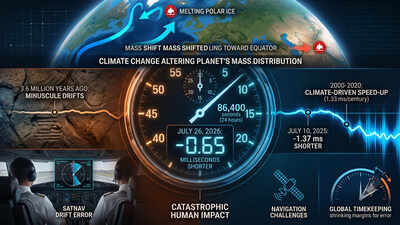
In an unusual astronomical development, scientists have warned that the “shortest day of 2026” is expected to occur later this month, as Earth completes a slightly faster rotation than usual. While the difference may appear negligible—measured in mere milliseconds—it has raised concerns among experts about its potential impact on critical technologies such as GPS navigation and satellite operations.
A Day Shorter Than 24 Hours
A standard day on Earth lasts 24 hours, or precisely 86,400 seconds. However, due to variations in Earth’s rotation speed, this duration is not always constant. According to researchers, the upcoming shortest day could be shorter by around 1 to 2 milliseconds. Though this time difference is imperceptible to humans, it is significant for systems that rely on extremely precise timekeeping.
Scientists attribute these fluctuations to a range of natural factors, including movements within Earth’s core, changes in atmospheric pressure, ocean currents, and even seismic activity. Seasonal variations and the gravitational pull of the Moon also play a role in subtly altering the planet’s spin.
Why Milliseconds Matter
Modern technology depends heavily on precise timing. Global Positioning System (GPS) satellites, financial networks, telecommunications systems, and data centers all rely on atomic clocks that measure time with extreme accuracy. Even a discrepancy of a few milliseconds can lead to errors.
For instance, GPS systems determine location by calculating the time it takes for signals to travel from satellites to receivers on Earth. A tiny misalignment in timing could result in location errors of several meters. While that may not seem critical in everyday navigation, it can pose serious risks for aviation, military operations, and autonomous vehicles.
Similarly, satellite communication systems could face synchronization issues, potentially affecting broadcasting, weather monitoring, and global internet services.
The Leap Second Challenge
To address long-term variations in Earth’s rotation, scientists have historically used “leap seconds”—an adjustment added to Coordinated Universal Time (UTC) to keep clocks aligned with Earth’s actual rotation. However, the current trend of Earth spinning slightly faster has sparked discussions about the possibility of a “negative leap second,” where a second would be removed instead of added.
This concept, though theoretically straightforward, presents practical challenges. Many computer systems and networks are not designed to handle a negative leap second, raising concerns about software glitches, system crashes, or data inconsistencies.
Growing Concerns Among Experts
Timekeeping authorities and space agencies are closely monitoring the situation. Experts warn that even minor irregularities in Earth’s rotation could accumulate over time, leading to larger discrepancies if not properly managed.
“There is a growing need to rethink how we handle time adjustments in a world that depends on nanosecond-level precision,” said one researcher involved in global timekeeping studies. “What seems like a tiny change in Earth’s rotation can have cascading effects on modern infrastructure.”
Preparing for the Future
Organizations responsible for global time standards are exploring alternatives to leap seconds, including redefining how UTC is calculated. Some experts suggest moving toward a continuous time system that does not require periodic adjustments, while others advocate for improved software resilience to handle such anomalies.
Meanwhile, engineers and scientists are working to ensure that satellite systems and communication networks remain robust against these minor but impactful changes.
A Subtle Reminder of Earth’s Complexity
The phenomenon of the shortest day serves as a reminder that Earth is a dynamic and ever-changing system. While the difference of a few milliseconds may go unnoticed in daily life, its implications highlight the delicate balance between natural processes and human-made technology.
As the world becomes increasingly dependent on precision timing, even the smallest shifts in Earth’s rotation are proving to be more than just a scientific curiosity—they are a challenge that modern technology must be ready to face.