
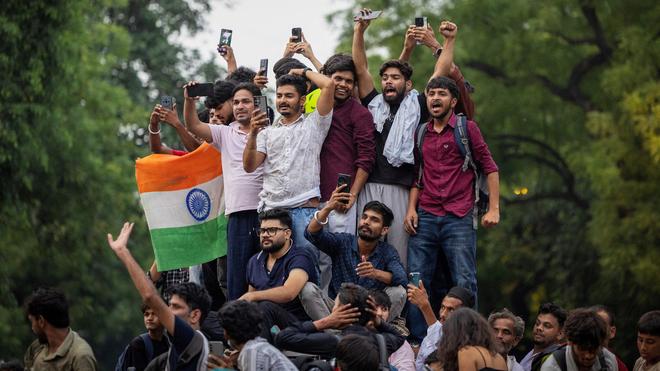
Source The Hindu
New Delhi — In a dramatic political development unfolding alongside ongoing protests at Jantar Mantar, President Droupadi Murmu has formally accepted the resignation of Union Education Minister Dharmendra Pradhan. The decision comes at a time of heightened public scrutiny over the functioning of the education system, with protests intensifying in the national capital.
Soon after the resignation was approved, the government announced that senior minister Pralhad Joshi would take over charge of the Ministry of Education. The transition is being seen as a swift attempt by the Centre to stabilize the situation and respond to mounting pressure from students, educators, and opposition parties.
Background of the Crisis
The protests at Jantar Mantar have been ongoing for several days, drawing participation from students, job aspirants, and civil society groups. Demonstrators have raised concerns over alleged irregularities in examination processes, delays in recruitment, and broader issues related to transparency and accountability in educational institutions.
The agitation intensified after a series of controversies linked to national-level examinations, which many protesters claim have undermined trust in the system. The growing unrest put the spotlight squarely on the Education Ministry, leading to increased calls for accountability.
Resignation and Political Fallout
Sources within the government indicated that Pradhan’s resignation was submitted earlier in the day and accepted without delay. While no official statement directly linked his exit to the protests, political analysts believe the move is a response to public sentiment and the need to contain the crisis.
Opposition leaders have described the resignation as “long overdue,” alleging administrative lapses and failure to address grievances in a timely manner. Meanwhile, ruling party representatives have framed it as a responsible step, emphasizing that leadership changes are part of ensuring better governance.
New Leadership, Immediate Challenges
Pralhad Joshi, who has held multiple key portfolios in the past, now faces the immediate challenge of restoring confidence in the education system. His first tasks are expected to include engaging with stakeholders, reviewing examination protocols, and addressing the concerns of protesting groups.
Government officials suggest that Joshi may initiate a comprehensive review of existing systems to prevent future controversies. There are also indications that a high-level committee could be formed to examine the issues raised by students and recommend reforms.
Situation at Jantar Mantar
On the ground, protests at Jantar Mantar continue, though authorities have maintained a controlled environment to avoid escalation. Security has been tightened, and police presence remains significant, but no major clashes have been reported so far.
Protesters have welcomed the resignation as a partial victory but insist that structural reforms are necessary. Many have stated that their agitation will continue until concrete steps are taken to address their demands.
Broader Implications
The leadership change in the Education Ministry is likely to have far-reaching implications. It underscores the political sensitivity of education-related issues, particularly in a country where millions of students depend on fair and efficient examination systems.
Experts believe that the government’s next steps will be crucial in determining whether the situation de-escalates or intensifies further. Transparent communication, swift policy action, and meaningful engagement with stakeholders are expected to be key factors in resolving the crisis.
Conclusion
As the nation watches closely, the resignation of Dharmendra Pradhan and the appointment of Pralhad Joshi mark a significant turning point in the ongoing controversy. While the immediate political response has been swift, the real test lies ahead in addressing the root causes of discontent and rebuilding trust in India’s education system.









