
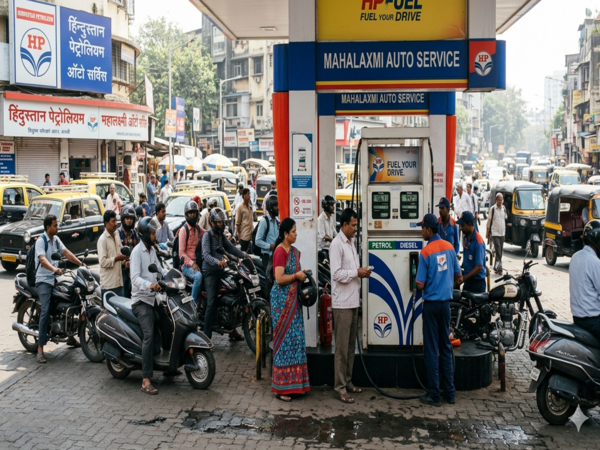
Source The economics Times
NEW DELHI — Despite a widening financial gap and mounting global energy pressures, India’s state-run Oil Marketing Companies (OMCs) continue to hold retail fuel prices steady, shielding domestic consumers from the volatility of the international market. Recent data reveals that Indian Oil Corporation (IOC), Bharat Petroleum (BPCL), and Hindustan Petroleum (HPCL) are currently absorbing an staggering ₹30,000 crore monthly under-recovery to prevent a price hike at the pump.
The Financial Strain
The current geopolitical crisis in West Asia has significantly disrupted supply routes, particularly through the Strait of Hormuz, pushing global crude prices toward the $100 per barrel mark. While many nations have passed these costs directly to citizens, the Indian government has prioritized economic stability.
According to Sujata Sharma, Joint Secretary in the Petroleum Ministry, the OMCs are facing daily losses of approximately ₹1,600 to ₹1,700 crore. To mitigate some of this pressure, the government previously slashed excise duties by ₹10 per litre, a move that costs the national exchequer roughly ₹14,000 crore per month.
Fuel Rates Across Major Cities (May 10, 2026)
As of today, retail prices remain unchanged in major metros. Here is the latest price breakdown:
City Petrol Price (per litre) Diesel Price (per litre)
New Delhi ₹94.77 ₹87.67
Mumbai ₹103.54 ₹90.03
Kolkata ₹105.41 ₹92.02
Chennai ₹100.84 ₹92.39
Bengaluru ₹102.96 ₹90.99
Hyderabad ₹107.50 ₹95.70
A Call for Restraint
Speaking at a recent event in Hyderabad, Prime Minister Narendra Modi addressed the energy situation, urging citizens to use petroleum products with “great restraint.” He emphasized that reducing imported fuel consumption is the “need of the hour” to save foreign exchange and minimize the economic impact of the ongoing West Asia conflict.
While the Petroleum Ministry has dismissed recent rumors of an immediate post-election “mega-hike” as fake news, analysts suggest that if global crude remains above $100 for an extended period, the current model of OMC absorption may become unsustainable in the long run.
For now, the government continues to focus on expanding solar power and ethanol blending to reduce the country’s 88% dependence on crude imports.
Key Takeaway: While global prices surge, Indian consumers remain protected by a massive financial buffer provided by the state, though officials warn that energy conservation is critical for national economic health.









