
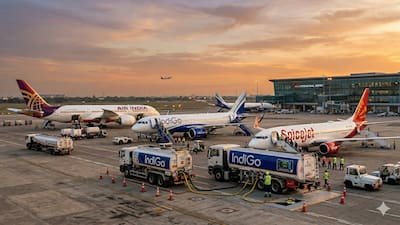
Source NDTV
NEW DELHI — In a major move to protect travellers from soaring ticket prices and steady the shaky aviation sector, the Union Cabinet on Wednesday approved a massive ₹10,000 crore Price Stabilisation Fund for Aviation Turbine Fuel (ATF).
The decision comes as a direct response to a massive global energy squeeze. Triggered heavily by the ongoing West Asia crisis and geopolitical conflict, international jet fuel prices have sky-rocketed by nearly 2.5 times in just two months—surging from ₹60.5 per litre in March to a staggering ₹142 per litre by May.
To break this impact, the government has officially capped domestic jet fuel prices at ₹75.6 per litre, bringing massive, immediate relief to Indian air carriers.
How the Relief Fund Works
Because fuel constitutes roughly 40% to 60% of an airline’s total operational costs, sudden price spikes easily destabilize an entire carrier’s budget. The newly approved ₹10,000 crore fund operates as an interest-free financial buffer distributed through the Ministry of Petroleum and Natural Gas to state-run Oil Marketing Companies (OMCs).
The Subsidy Mechanism: OMCs will supply jet fuel to participating scheduled Indian airlines at the fixed government benchmark price. The ₹10,000 crore fund will be used to directly absorb and compensate the losses incurred by OMCs while global prices stay high.
A Self-Sustaining Model: This is a revolving, temporary fund scheduled to stay active for 36 months. Once international crude and ATF prices cool back down below the threshold, OMCs will gradually recover the variance from airlines and return the money to the Consolidated Fund of India.
Saving 77 Lakh Jobs and Crucial Air Routes
Briefing reporters on the landmark policy, Information and Broadcasting Minister Ashwini Vaishnaw highlighted that the decision isn’t just about corporate relief—it is heavily tailored to safeguard everyday citizens and the broader economy.
“With this fund, airlines will get a stable ATF price as long as the global turmoil is there. It will shield air passengers from volatile fare spikes driven by global oil shocks, and protect up to 77 lakh jobs tightly woven into the aviation and tourism ecosystem,” Minister Vaishnaw stated.
The government also noted that keeping airlines viable is absolutely vital to safeguarding massive public investments in airport infrastructure. It ensures uninterrupted flight operations continue running smoothly into regional Tier-II and Tier-III zones under the UDAN connectivity scheme, while maintaining longer, costlier international flight routes to Europe and North America that are currently forced to detour around closed Pakistani airspace.
Following the announcement, investors reacted positively, pushing aviation stocks like IndiGo’s parent company, InterGlobe Aviation, higher on the stock market.









