
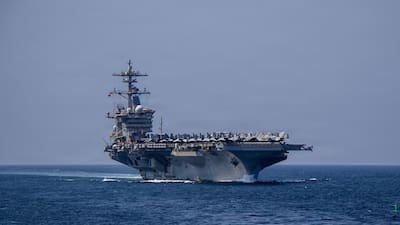
Source NDTV World
The Strait of Hormuz, a narrow yet vital waterway connecting the Persian Gulf to the Arabian Sea, has once again become the focal point of rising geopolitical tensions. While much of the global narrative continues to emphasize Iran’s assertive posture in the region, emerging developments suggest that the United States may be grappling with a broader and more complex challenge—one that extends beyond Tehran’s resistance.
For decades, the United States has maintained a strong naval presence in the Gulf, positioning itself as the primary guarantor of maritime security and the uninterrupted flow of global oil supplies. Nearly a fifth of the world’s petroleum passes through the Strait of Hormuz, making stability in the region essential not just for Middle Eastern economies but for global markets at large. However, recent incidents involving commercial shipping disruptions, increased military posturing, and shifting alliances have exposed vulnerabilities in Washington’s long-standing strategic dominance.
At the heart of the issue lies a changing regional dynamic. Iran, despite economic sanctions and diplomatic isolation, has demonstrated resilience by leveraging asymmetric tactics and strengthening ties with regional partners. Its ability to disrupt maritime traffic without engaging in direct confrontation has complicated traditional military responses. Yet, focusing solely on Iran risks overlooking a deeper concern: the gradual erosion of U.S. influence in the Gulf.
Several Gulf nations, once firmly aligned with Washington, are diversifying their strategic partnerships. Countries such as Saudi Arabia and the United Arab Emirates have increasingly engaged with global powers like China and Russia, seeking economic and security cooperation beyond the U.S. framework. This shift reflects a broader recalibration of foreign policy priorities, driven by energy transitions, economic diversification, and a desire for strategic autonomy.
Moreover, the U.S. faces internal constraints that limit its ability to respond decisively. War fatigue among the American public, competing global priorities—including tensions in the Indo-Pacific—and domestic political divisions have all contributed to a more cautious approach. Maintaining a large-scale military commitment in the Gulf is becoming increasingly difficult to justify, even as regional threats persist.
Energy dynamics are also playing a crucial role in reshaping the equation. As the United States reduces its dependence on Middle Eastern oil due to increased domestic production and renewable energy investments, its strategic imperative to police the Strait of Hormuz is evolving. While global stability remains a concern, the direct economic stakes for Washington are not as high as they once were, potentially altering its long-term commitment to the region.
Experts argue that this combination of factors—regional realignments, shifting energy priorities, and domestic limitations—constitutes a more significant challenge for the United States than Iran’s actions alone. Tehran’s resistance, while impactful, operates within a broader context where U.S. influence is no longer uncontested.
In response, Washington has sought to strengthen multilateral security initiatives, encouraging allied nations to share the burden of safeguarding maritime routes. However, these efforts have met with mixed success, as differing national interests and strategic calculations hinder cohesive action.
As tensions in the Strait of Hormuz continue to simmer, the situation underscores a critical reality: the United States is navigating a complex strategic transition. While Iran remains a key player in the regional equation, the larger challenge for Washington lies in adapting to a multipolar Middle East where influence is increasingly diffused.
The evolving scenario raises important questions about the future of global energy security and the role of traditional power structures in maintaining it. For now, the Strait of Hormuz stands not only as a geopolitical flashpoint but also as a symbol of shifting global power dynamics—where the United States must confront challenges that go far beyond a single adversary.









