
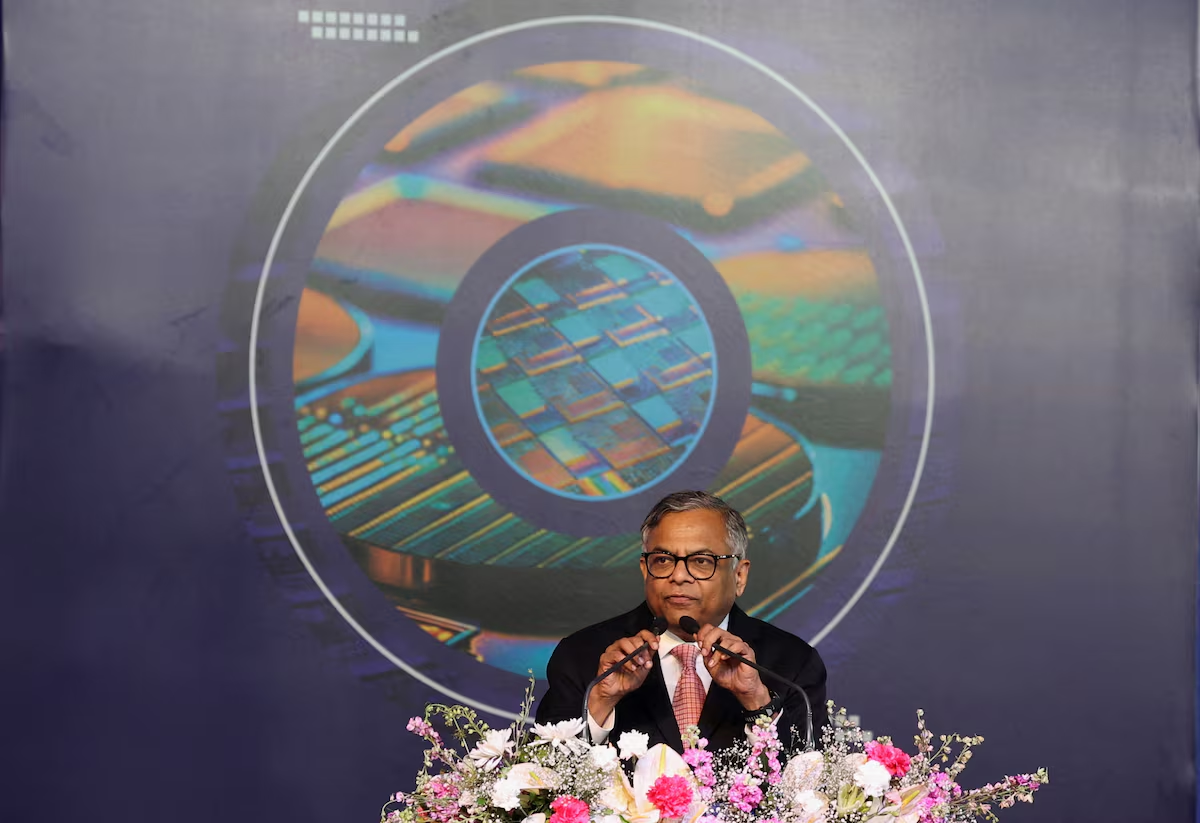
Source Reuter
MUMBAI — In a major statement reflecting the changing landscape of India’s $315-billion technology services industry, Tata Consultancy Services (TCS) Chairman N. Chandrasekaran announced that the company intends to deploy half a million artificial intelligence (AI) agents over the next three years—effectively matching its current human workforce.
While the mass deployment of autonomous AI systems marks a historic technological shift for India’s largest IT exporter, Chandrasekaran sought to temper anxiety regarding potential job losses, explicitly ruling out workforce downsizing. However, he freely acknowledged that the corporate recruitment playbook is undergoing a permanent transformation.
“The Day is Not Far”
Addressing shareholders at the company’s 31st Annual General Meeting, Chandrasekaran outlined a future where human employees and software-based AI agents operate side-by-side.
“The company has half a million employees. The day is not far when the company will have half a million AI agents,” Chandrasekaran stated. “There is no downsizing of staff. That is not planned at all. We just want to have the right talent, and we want to use the agents.”
Despite the reassurance that current employees will not face layoffs, the chairman directly addressed the inevitable cooling effect this automation will have on future entry-level and volume-based hiring—particularly the massive campus recruitment drives that have traditionally defined the Indian IT landscape.
When asked directly if the expansion of AI infrastructure would lead to a reduction in recruitment, Chandrasekaran replied, “Absolutely. The company will not be hiring the kind of numbers it used to hire because certain portions of the work in the current scheme of things will go to AI agents.”
Reshaping the IT Business Model
For decades, the standard operating model for Indian IT service giants has been heavily reliant on headcount: adding more engineers to scale revenue. The rapid emergence of generative AI and automated “digital workers” threatens to decouple growth from physical recruitment.
TCS’s total headcount dropped by over 23,000 employees during the financial year ended March 2026, resting at roughly 5.84 lakh (584,000) workers. While softer global client spending and macroeconomic headwinds initially triggered the contraction, the integration of autonomous agents is expected to keep hiring numbers modest moving forward.
Instead of mass engineering recruitment, Chandrasekaran explained that human resources metrics will evolve to prioritize specialized skill sets over volume.
A Historic Business Opportunity
Far from viewing the shift as a threat to the technology sector, the TCS chairman framed AI as the single greatest commercial opportunity in the company’s history.
Surging AI Revenues: TCS’s annualized AI revenue run-rate reached $2.4 billion in the final quarter of the last fiscal year, growing at a steep compound quarterly growth rate of over 22%.
The “AI Component” Future: Management projects that by 2028 to 2030, 100% of TCS’s enterprise revenue will feature an active AI component.
Heavy Infrastructure Outlays: To support this transition, TCS is stepping away from its traditionally “asset-light” philosophy to actively invest in specialized AI data centers and sovereign cloud systems capable of running industry-specific agent networks.
As the industry moves through this transitional phase, TCS leadership maintains that while repetitive, repeatable tasks will permanently migrate to machine intelligence, the transition will eventually generate entirely new categories of high-value tech roles. For the broader Indian technology sector, however, the message is clear: the era of linear expansion through sheer human headcount has drawn to a close.









