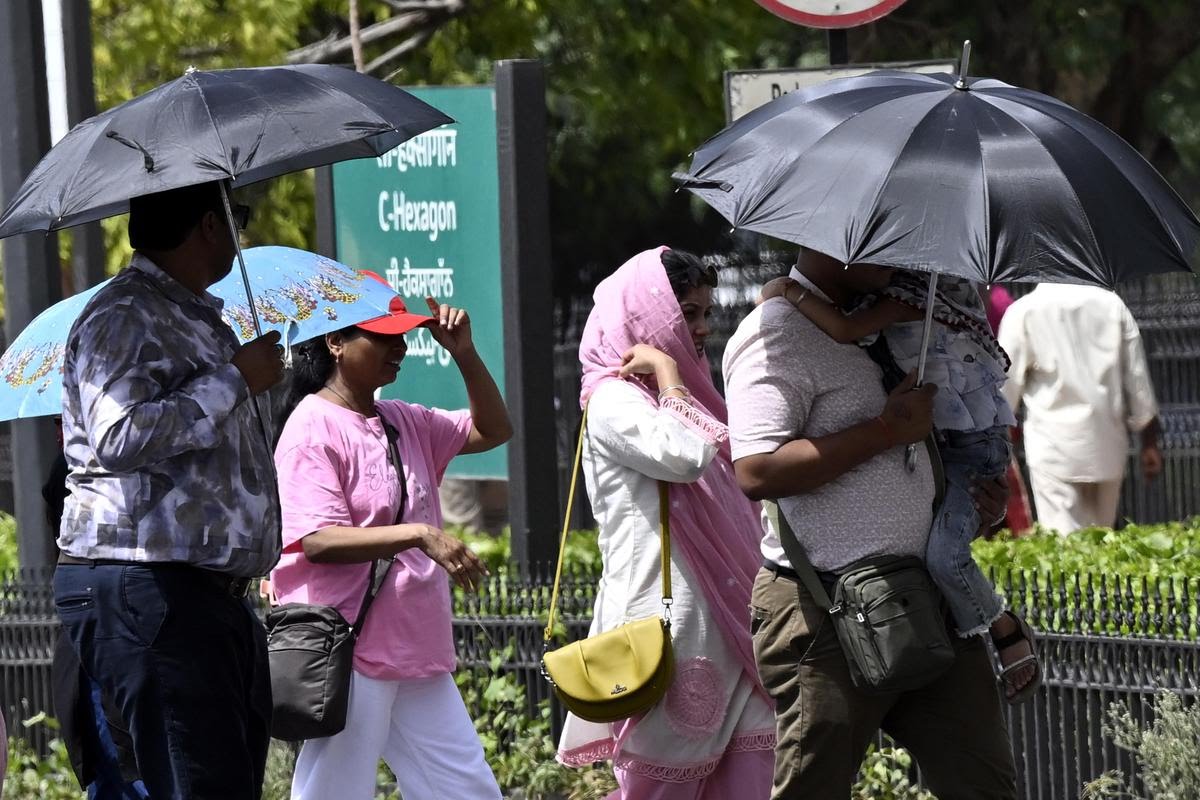
Source The Hindu
NEW DELHI — Large swathes of central and northwest India remain locked in a punishing pre-monsoon heatwave, with temperatures crossing seasonal averages and shattering local records. The severe weather comes as the highly anticipated southwest monsoon remains lingering offshore, missing its standard landing timeline and extending the mainland’s dry, sweltering summer.
According to data released by the India Meteorological Department (IMD), the mercury has consistently breached the 45^\circ\text{C} mark across multiple states, driving up power grids and presenting severe public health challenges.
Merciless Mercury: Record Highs and Sleepless Nights
The epicenter of the current heatwave spans across Rajasthan, Madhya Pradesh, Haryana, Vidarbha (Maharashtra), and Uttar Pradesh. Banda in Uttar Pradesh recorded the season’s highest temperature, with the mercury touching an astonishing 47.4^\circ\text{C} (117.3^\circ\text{F}). Meanwhile, the National Capital Region (NCR) of Delhi has been reeling under daytime highs ranging between 43^\circ\text{C} and 45^\circ\text{C}.
Meteorologists point out that the real danger this season isn’t just the daytime peak, but a worrying trend of “warm nights.” Delhi recorded its warmest May night in nearly 14 years, with a minimum nighttime temperature of 32.4^\circ\text{C}. Experts warn that without evening cooling, the human body suffers cumulative heat stress, drastically increasing the risk of heat exhaustion and chronic conditions.
Why the heat is so intense: A severe lack of pre-monsoon weather systems over the mainland has allowed scorching north-westerly winds from the desert regions of Rajasthan and Sindh (Pakistan) to penetrate deep into central India completely unhindered.
Public Health Warnings and a Strained Power Grid
In response to the compounding alerts, Prime Minister Narendra Modi issued a public appeal via X (formerly Twitter), urging citizens to stay hydrated and recognize the symptoms of heat exhaustion, such as dizziness, nausea, and acute fatigue. The government highlighted that outdoor workers, the elderly, and children are facing the highest vulnerability.
The heat has also triggered an unprecedented surge in peak electricity demand as millions turn to air conditioning for survival. At the India Heat Summit, Simon Stiell, Executive Secretary of the United Nations Framework Convention on Climate Change (UNFCCC), addressed the crisis directly, calling extreme heat “India’s burning issue” and linking the regular frequency of these multi-week events directly to global climate change.
Monsoon Status and Regional Contrast
While the north and central plains burn, the southern and eastern edges of the country are experiencing a completely different weather story. Heavy rains and thunderstorms are battering the Northeast, parts of Kerala, and Tamil Nadu.
The primary cause for the extended heatwave is the slow progress of the southwest monsoon over the mainland:
The Offshore Stall: The monsoon has advanced into parts of the Arabian Sea, Lakshadweep, and the Bay of Bengal, but its critical official landfall over the Kerala coast remains just out of reach.
The El Niño Shadow: Forecasters warn that the equatorial Pacific is transitioning rapidly into an El Niño phase—a warming pattern known to suppress Indian monsoon rainfall. There is currently a 98% probability of El Niño persistence through the mid-summer months, raising long-term concerns for agricultural yields.
Relief in Sight: The Coming Western Disturbance
Fortunately, meteorologists promise that a break in the unrelenting heat is imminent. The IMD announced that a fresh Western Disturbance—a moisture-laden weather system originating from the Mediterranean region—is expected to impact northwest India.
The incoming system is projected to trigger a sharp drop in temperatures by 6^\circ\text{C} to 8^\circ\text{C} across the northern plains. While the relief will be accompanied by turbulent conditions, including squally winds up to 70 km/ph, dust storms, and localized hailstorms, it will finally break the back of this historic May heatwave.