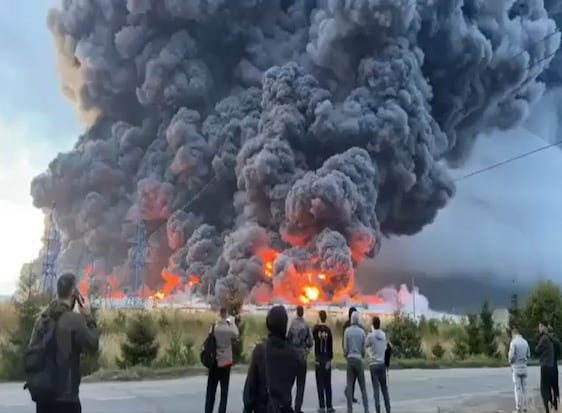
Source NDTV World
Moscow Region, Russia — A large-scale drone attack targeting areas around Moscow triggered massive fires, widespread destruction, and panic among residents late Saturday night, marking one of the most intense aerial assaults reported in the region in recent months.
According to preliminary reports from regional authorities, multiple unmanned aerial vehicles (UAVs) were detected entering Russian airspace in coordinated waves. Air defense systems were activated immediately, intercepting several drones mid-air. However, a number of drones managed to evade interception and struck residential and industrial zones, igniting what eyewitnesses described as an “apocalyptic blaze.”
Videos circulating on social media showed towering flames engulfing buildings, thick black smoke rising into the night sky, and emergency sirens echoing across neighborhoods. Residents reported hearing loud explosions followed by power outages in several districts, intensifying the sense of chaos.
Emergency services rushed to the affected sites, deploying firefighters, medical teams, and rescue personnel. Authorities confirmed that multiple structures, including warehouses and residential complexes, sustained severe damage. Firefighters battled through the night to contain the blazes, with some hotspots still smoldering by early morning.
Casualty figures remain unclear, but officials acknowledged that several individuals were injured, with some requiring hospitalization. Efforts are ongoing to assess the full extent of the damage and locate anyone who may be trapped under debris.
Local authorities urged residents to remain indoors and avoid affected areas as a precaution. “All necessary measures are being taken to ensure public safety and restore normalcy,” a regional emergency spokesperson said in a statement. Temporary shelters have been set up for those displaced by the fires.
The attack has further escalated tensions in the region, with officials describing it as a “deliberate and coordinated act aimed at destabilizing civilian infrastructure.” While no group has officially claimed responsibility, investigations are underway to determine the origin and intent behind the drone strikes.
Security has been heightened across Moscow and surrounding areas, with additional air defense units deployed and surveillance intensified. Airports in the region briefly suspended operations as a precaution, causing disruptions to air travel.
Analysts note that the increasing use of drone warfare in the conflict underscores a shift toward more unpredictable and decentralized tactics. The ability of drones to penetrate heavily defended areas raises concerns about the vulnerability of urban centers to such attacks.
Residents, still shaken by the night’s events, described scenes of fear and confusion. “It felt like the sky was on fire,” said one local, recounting the moment explosions lit up the horizon. “We didn’t know what was happening—only that we had to run.”
As cleanup and recovery efforts continue, authorities have pledged to strengthen defensive measures and conduct a thorough review of existing security protocols. Meanwhile, the international community is closely monitoring the situation, with calls for restraint and de-escalation growing louder.
The incident stands as a stark reminder of the evolving nature of modern conflict, where technology enables strikes far from traditional frontlines, bringing the realities of war directly into civilian spaces.