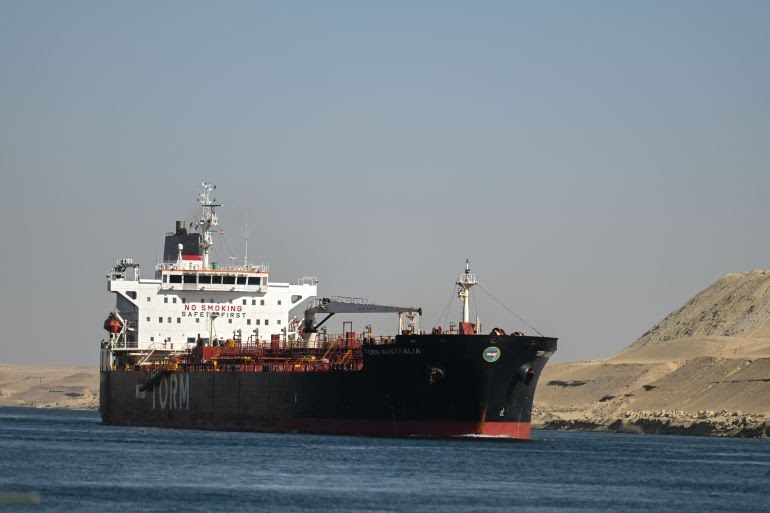
Source Aljajeera
SINGAPORE / DUBAI — As Yemen’s Houthi movement enforces a naval blockade on the strategic Bab al-Mandeb Strait, major Asian oil refiners are scrambling for workaround routes to secure crucial Middle Eastern crude. While energy traders are turning to Egypt’s Suez Canal as a potential escape hatch for Saudi Arabian crude loaded at the Red Sea port of Yanbu, market analysts warn that the canal is a costly, convoluted detour rather than a silver bullet for Asia’s energy security.
The Great Red Sea Bottleneck
For decades, the standard eastbound route for Saudi crude originating from Yanbu was straightforward: sail south through the narrow 20-mile-wide Bab al-Mandeb Strait into the Gulf of Aden, then chart a direct course across the Indian Ocean to Asian refining hubs in India, China, and South Korea.
However, with military tensions escalating and Houthi forces targeting commercial vessels at the southern entrance of the Red Sea, several oil tankers carrying Asian-bound crude have abruptly reversed course.
The Dilemma: Saudi Arabia’s East-West pipeline allows state energy giant Saudi Aramco to bypass the troubled Strait of Hormuz by pumping up to 5 million barrels per day across the peninsula to Yanbu. But with Bab al-Mandeb blocked to the south, crude sitting in the Red Sea is effectively trapped in a geographic cul-de-sac.
Why the Suez Detour Flunks the Logistics Test
To avoid turning back, refiners—including South Korea’s Hyundai Oilbank and several Indian buyers—have considered sending tankers north through Egypt’s Suez Canal and the SUMED pipeline. On paper, exiting into the Mediterranean Sea allows vessels to keep moving. In practice, getting that oil to Asian refineries creates a supply-chain nightmare:
Massive Route Diversion: To reach Asia from the Mediterranean, tankers must cross the entire length of the Mediterranean Sea, pass through the Strait of Gibraltar into the Atlantic, and steam thousands of miles around the southern tip of Africa (the Cape of Good Hope) before reaching the Indian Ocean.
Extreme Time Delays: The detour adds between 21 to 28 days (3 to 4 weeks) to standard voyage times compared to transiting Bab al-Mandeb directly.
Supertanker Capacity Limits: Very Large Crude Carriers (VLCCs)—the workhorses of long-haul Asian energy imports—are too deep when fully loaded to transit the Suez Canal. Shippers must discharge partial cargo into Egypt’s SUMED pipeline on the Red Sea side and reload it in the Mediterranean, dramatically increasing operational complexity and transit fees.
Soaring Freight & Fuel Costs: Longer sailing times lock up tanker capacity for twice as long, sending charter rates, fuel consumption, and maritime insurance premiums soaring.
Impact on Key Asian Energy Buyers
Reason Primary Exposure Alternative Options
IndiaHeavy importer of Middle Eastern and Russian crude passing through Red Sea corridors.Rerouting tankers around Africa or pivoting toward spot cargoes from West Africa and the US Gulf Coast.
China & South KoreaReliant on long-term Saudi crude contracts shipped on VLCCs.Absorbing high freight premiums or lightering cargoes through Suez/SUMED.
The Bottom Line
The Suez Canal provides a physical passage out of the Red Sea, but it cannot solve the geographical reality facing Asian importers. Routing Middle Eastern oil west into Europe’s backyard only to ship it thousands of miles back east around Africa is an expensive emergency maneuver. Until security is restored at Bab al-Mandeb, Asian consumers will likely face elevated energy prices, longer delivery windows, and an increasingly fragile global supply chain.