
Source TOI
NEW DELHI — India has issued a sharp, categorical rebuttal to the recent joint statement issued by China and Pakistan, firmly rejecting all references to the Union Territories of Jammu & Kashmir and Ladakh.
The Ministry of External Affairs (MEA) reasserted that these regions remain an “integral and inalienable” part of the country, while simultaneously blasting the China-Pakistan Economic Corridor (CPEC) as an illegal violation of Indian sovereignty.
“No Locus Standi”
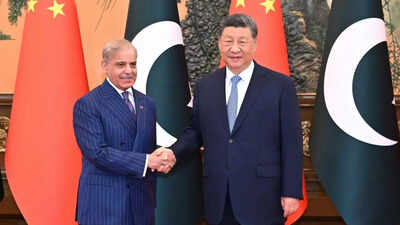
The diplomatic friction follows Pakistan Prime Minister Shehbaz Sharif’s official four-day visit to China, which concluded on May 26. In a joint communique released at the end of high-level talks between Sharif and Chinese Premier Li Qiang, Pakistan briefed Beijing on the “latest developments” in Jammu and Kashmir. The statement went on to characterize the Kashmir issue as a “dispute left over from history,” calling for its peaceful resolution under the United Nations Charter and relevant Security Council resolutions.
Responding to media queries on Tuesday, MEA Spokesperson Randhir Jaiswal stated that India “categorically rejects” these unwarranted references.
“Our position is consistent and well known to the concerned parties. The Union territories of Jammu & Kashmir and Ladakh have been, are and will always remain integral and inalienable parts of India. No other country has the locus standi to comment on the same,” Jaiswal affirmed.
Fierce Opposition to CPEC Infrastructure
New Delhi also renewed its aggressive stance against the multi-billion dollar CPEC infrastructure project, a crown jewel of Beijing’s Belt and Road Initiative (BRI). Because parts of the corridor run through Pakistan-occupied Kashmir (PoK), India views the projects as a direct infringement on its territorial borders.
“As regards the so-called China-Pakistan Economic Corridor projects, some of which are in India’s sovereign territory, we resolutely oppose and reject any moves by other countries to reinforce or legitimise Pakistan’s illegal and forcible occupation of these territories,” Jaiswal said. He added that India’s deep concerns regarding these projects have been clearly communicated to both Beijing and Islamabad on multiple occasions.
Water Cooperation Claims Dismissed
The MEA spokesperson took the rebuttal a step further by dismissing mentions of “trans-boundary water resources cooperation” between China and Pakistan featured in the joint text.
Pointing out a simple geographical fact, Jaiswal noted that since China and Pakistan do not share a legitimate, recognized physical boundary, the concept of trans-boundary water cooperation between them is legally untenable. India further reiterated that it has never recognized the 1963 boundary agreement under which Pakistan unlawfully ceded the Shaksgam Valley to China.
Tensions surrounding these joint declarations have remained a persistent flashpoint in South Asian geopolitics, particularly since August 2019, when India revoked Article 370 to end the special autonomous status of Jammu and Kashmir.









