
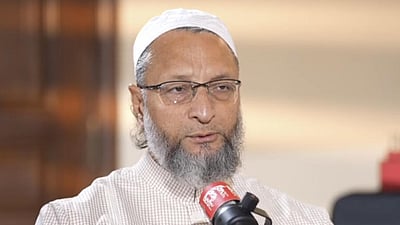
Source Deccan Herald
MUMBAI: AIMIM President Asaduddin Owaisi has raised serious concerns over the nature of contemporary news reporting, asserting that the media is increasingly overstepping its boundaries by acting as “judge and jury.” His comments came in response to the ongoing coverage surrounding Nida Khan in the “TCS case,” which he cited as a prime example of a “media trial.”
The Hyderabad MP took to social media and public addresses to criticize the sensationalism surrounding the case, arguing that the press is bypassing the due process of law. Owaisi emphasized that the responsibility of determining guilt or innocence lies solely with the judiciary, not with news anchors or television panels.
“The media acting as judge and jury is a dangerous trend for our democracy,” Owaisi stated. He argued that when the press conducts its own parallel trials, it not only prejudices public opinion but also creates immense pressure on the legal system, potentially compromising the right to a fair trial.
The “TCS case” has recently dominated headlines, with various outlets providing minute-by-minute commentary on the involvement of Nida Khan. Owaisi suggested that this “trial by media” often relies on unverified leaks and speculative narratives rather than hard evidence presented in a court of law.
Legal experts have frequently echoed these sentiments, noting that excessive media scrutiny can lead to character assassination before a suspect has even had the chance to defend themselves legally. Owaisi’s critique highlights a growing friction between the media’s right to report and the individual’s right to be presumed innocent until proven guilty.
By questioning the media’s approach to the Nida Khan investigation, Owaisi has reignited a national debate on journalistic ethics and the need for a self-regulatory framework that prevents news organizations from infringing upon the jurisdiction of the Indian courts.
The AIMIM chief concluded by urging the public to trust the judicial process and calling on media houses to return to objective reporting rather than delivering premature verdicts.









