Source Reuter
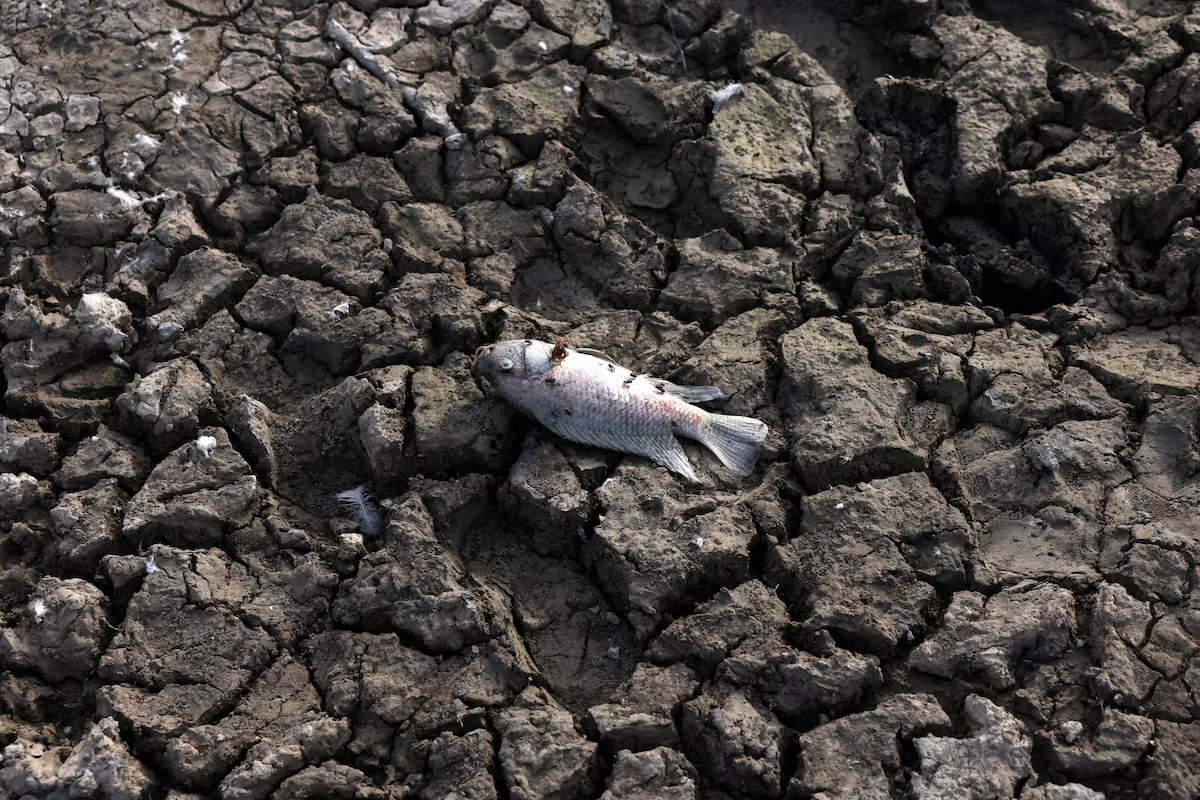
MUMBAI — June has drawn to a close as one of the driest opening months of the southwest monsoon since official record-keeping began 125 years ago. According to newly released data from the India Meteorological Department (IMD), the country faced a massive 39.8% rainfall deficit for the month, rendering it the fifth-driest June since 1901 and the most severe early-season dry spell in over a decade.
India received just 99.5 mm of cumulative rainfall against the long-period average (LPA) norm of 165.3 mm.
Why the Monsoon Stalled
The crippling shortfall stems from an unusually weak start and a prolonged pause in the monsoon’s journey. While the rain-bearing winds hit the southern coast of Kerala on June 4—just three days behind schedule—their northward and westward advance across key agricultural zones abruptly stalled for nearly two weeks.
Meteorologists point to a rare alignment of multiple unfavorable weather systems that choked off the monsoon’s moisture supply:
Missing Cyclones: Unlike recent years which saw early-season cyclones (like Remal in 2024 or Biparjoy in 2023) pull moisture deep inland, May and June saw zero low-pressure systems form in the North Indian Ocean.
Unfavorable Atmosphere: The Madden-Julian Oscillation (MJO)—a wave of rain-bearing clouds near the equator—shifted out of a favorable phase for the Indian subcontinent.
Emerging El Niño: A rapid transition from a La Niña winter into a strengthening El Niño in the equatorial Pacific Ocean has begun putting downward pressure on regional rainfall.
Impact on Farming and Temperatures
The dry spell has triggered immediate concerns for India’s nearly $4-trillion economy, where roughly half of the arable land lacks modern irrigation and depends entirely on summer rains.
RegionJune Rainfall DeficitMajor Crops Impacted
Central India-50% to -54%Soybeans, Corn, Pulses
East & Northeast India-40% to -44%Rice, Coarse Grains
Northwest India-30% to -31%Cotton, Paddy
South Peninsular India-27% to -28%Sugarcane, Oilseeds
The lack of rain has significantly slowed the sowing of crucial summer-sown (kharif) crops. Simultaneously, the lack of cloud cover has prolonged a grueling heatwave across the northern plains, trapping major agricultural regions in temperatures consistently exceeding 42°C (107.6°F).
A Silver Lining: While the historic June deficit has forced experts to keep a close eye on reservoir levels, weather officials emphasize that a dry June does not automatically doom the entire four-month season. Historically, years like 1926 started with similar sub-100 mm June deficits but recovered to finish well above normal.
The IMD projects that monsoonal winds will regain momentum in early July, with a fresh low-pressure system brewing in the Bay of Bengal expected to bring widespread, well-distributed rain to central and northern India.