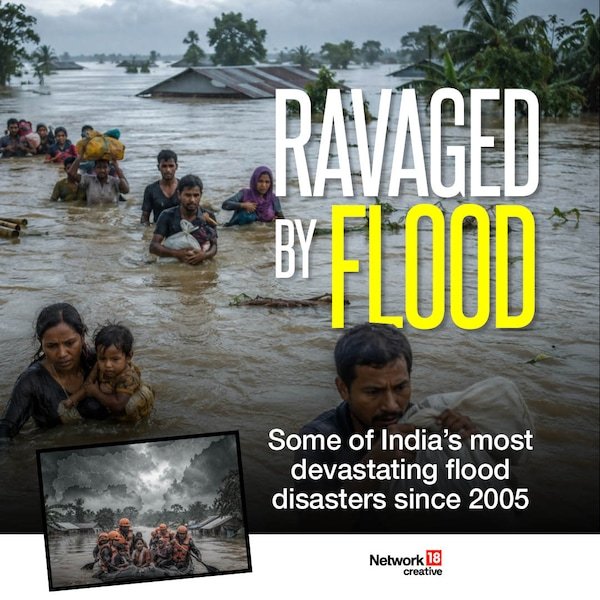
Source News 18
GUWAHATI — Millions of residents across Assam are confronting severe flooding once again as the mighty Brahmaputra and its 50-plus turbulent tributaries overflow, breaching embankments and submerging communities across multiple districts. Rescue personnel from the National Disaster Response Force (NDRF), state agencies, and armed forces remain deployed in full strength, navigating inundated roads to reach families stranded without food or drinking water.
The disaster in Assam highlights the country’s broader vulnerability to seasonal deluges, extreme weather events, and changing climate patterns. Nearly 40% of Assam’s land area is categorized as flood-prone—almost four times the national average.
A Grim Timeline: India’s Most Devastating Flood Disasters
While annual monsoons are crucial for agricultural livelihoods across South Asia, unyielding downpours and breached river basins have periodically unleashed catastrophic damage. Here is a look back at some of the most severe flood events in modern Indian history.
1. The 2013 Uttarakhand Deluge (“Kedarnath Flash Floods”)
In June 2013, explosive cloudbursts and rapid snowmelt triggered multi-day flash floods and massive debris flows across the Himalayan state of Uttarakhand. The Mandakini and Alaknanda rivers burst their banks, washing away ancient pilgrimage towns, bridges, and highways. The catastrophic tragedy claimed an estimated 5,700 lives, left tens of thousands stranded in harsh mountainous terrain, and remains one of India’s deadliest natural disasters in modern history.
2. The 2018 Kerala Floods
In August 2018, Kerala experienced its worst flooding in over a century following severe, continuous monsoon rainfall. All 35 major dams across the state were forced to open their sluice gates simultaneously to relieve water pressure. Over 480 people lost their lives, and more than 1 million residents were displaced into emergency shelters. The catastrophe caused widespread destruction to infrastructure and agriculture, prompting global relief responses.
3. The 1998 & 2004 Assam Floods
Assam has long served as the epicenter of monsoon-driven inundations. In 1998, intense rainfall submerged vast swaths of the Brahmaputra Valley, impacting over 4.7 million people and inflicting crippling economic losses. Six years later, in 2004, another historic surge swept through 31 districts, affecting over 12.6 million people and causing nearly 500 deaths—marking one of the state’s most damaging flood seasons on record.
4. The 2015 Chennai Floods
During November and December 2015, the annual Northeast Monsoon brought historic downpours to coastal Tamil Nadu, dumping nearly 500 mm of rain within 24 hours in some pockets. Coupled with poor urban drainage, overflowing reservoirs, and rapid marshland encroachment, the Tamil Nadu capital of Chennai was largely submerged. More than 500 people lost their lives, auto and technology manufacturing hubs ground to a complete halt, and economic losses exceeded ₹20,000 crore.
5. The 2005 Mumbai Deluge
On July 26, 2005, Mumbai recorded an extraordinary 944 mm (37.1 inches) of rainfall in a single 24-hour period. The sudden deluge overwhelmed the city’s century-old drainage network, bringing the financial capital to a standstill. Over 1,000 lives were lost due to drownings, landslides, and waterborne disease outbreaks in the days following the event.
Why Is Flood Severity Escalating?
Hydrologists and climate scientists point to a combination of natural and human-driven factors behind India’s intensifying flood threats:
Extremely Intense Spells of Rain: Changing climate dynamics are turning traditional, steady monsoon showers into localized, ultra-intense downpours (cloudbursts) that existing infrastructure cannot absorb.
Riverbank Siltation: Rivers like the Brahmaputra carry immense sediment loads from the Himalayas. Over time, silt deposition raises the riverbed height, significantly lowering channel capacity and prompting frequent overflows.
Ecological Strain & Encroachment: Rapid urbanization, illegal construction along natural drainage channels, wetland destruction, and aging embankments elevate risk levels during heavy rain events.
As Assam continues emergency relief operations, experts emphasize that long-term mitigation—including ecological restoration, smart urban planning, silt management, and updated drainage networks—is essential to prevent seasonal rainfall from repeatedly turning into widespread human tragedy.