Source The guardian
US President Donald Trump’s visit to Southeast Asia has attracted global attention as leaders gather for the ASEAN and APEC summits. While discussions on trade, security and regional cooperation are taking place, Trump’s arrival in Manila has also triggered protests, highlighting growing disagreements over US policies in the region.
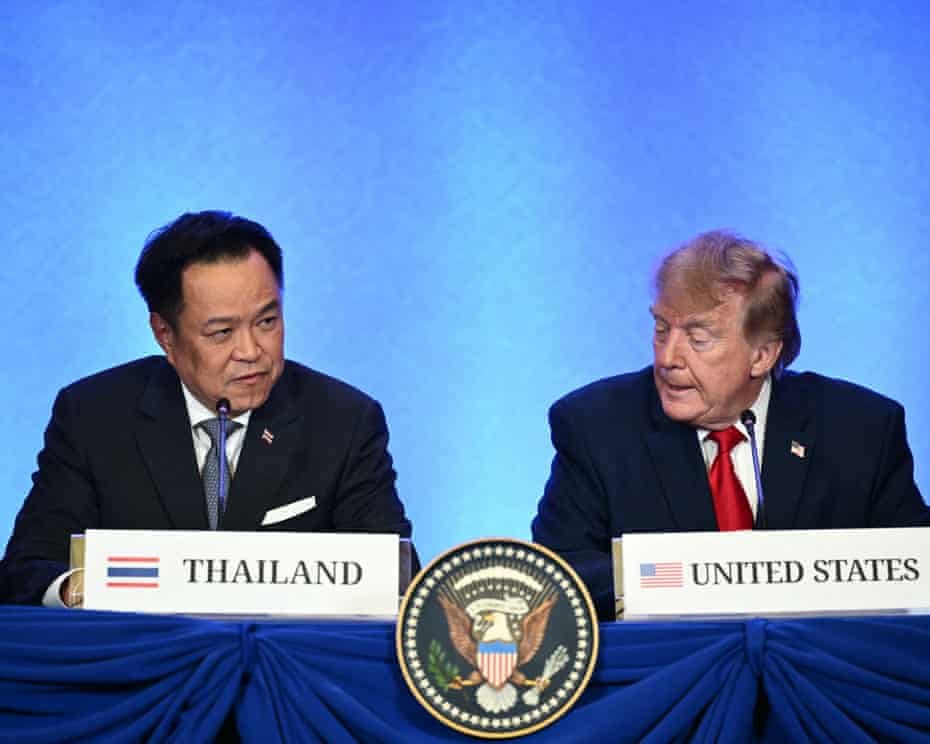
During his visit to the Philippines on Tuesday, November 17, Trump signed a joint trade statement with Thai Prime Minister Anutin Charnvirakul, marking major progress towards a new trade agreement between the United States and Thailand.
Trump Signs Major Trade Agreement With Thailand
One of the biggest developments during Trump’s visit was the announcement of a trade understanding between Washington and Bangkok.
Trump said Thailand had agreed to remove tariffs on US exports and reduce several trade barriers affecting American products. These include vehicles, medical equipment, medicines, poultry and ethanol.
Thailand has also committed to purchasing an estimated $2.6 billion worth of additional American agricultural products.
Trump described the development as a major victory for the United States and said the agreement would create new opportunities for businesses in both countries.
However, the formal trade agreement is expected to be completed in the coming weeks. The joint statement marks the substantial conclusion of negotiations rather than the final signing of the complete agreement.
Protests Greet Trump in Manila
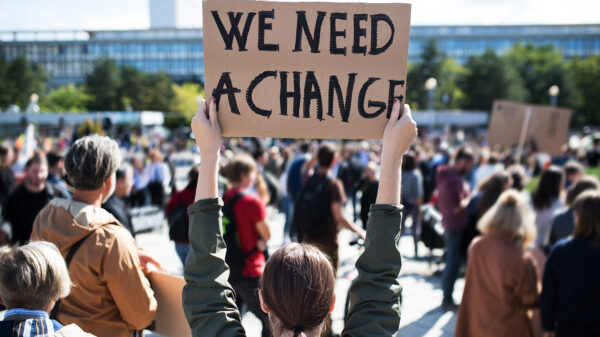
Trump’s arrival in Manila was accompanied by protests from groups opposing several American policies.
Demonstrators gathered in different parts of the Philippine capital, carrying banners and raising slogans against the US president. Some protesters also burned images of Trump to express their anger.
The demonstrations were largely linked to concerns over US foreign policy, the ongoing conflict in the Middle East and the proposed Pax Silica initiative.
The initiative aims to strengthen supply chains for artificial intelligence technology and important minerals. However, critics in the Philippines have raised concerns about its possible impact on local communities, water resources and the environment.
Protests had continued for several days before Trump’s arrival, creating additional pressure on the Philippine government.
Quad Leaders Discuss Regional Security
During his Manila visit, Trump also met leaders from India, Japan and Australia as part of the Quad grouping.
The meeting focused on regional security, economic cooperation, technology and concerns over China’s growing influence in the Indo-Pacific region.
The four countries discussed cooperation in areas such as artificial intelligence, critical minerals, infrastructure and maritime security.
The meeting was particularly important because it was the first gathering of Quad leaders in two years.
APEC Summit and China Meeting in Focus
After his engagements in the Philippines, Trump is scheduled to travel to Shenzhen, China, for the Asia-Pacific Economic Cooperation (APEC) summit.
The summit is expected to bring major world leaders together to discuss international trade, economic growth and regional stability.
A highly anticipated meeting involving Trump, Chinese President Xi Jinping and Russian President Vladimir Putin is also planned during the visit.
Issues involving international security, the wars in Ukraine and Iran, and relations between major powers are expected to attract attention.
A Major Test for International Relations
Trump’s Asia visit comes at a time of rising economic and political tensions across the world.
The ASEAN and APEC gatherings offer an important opportunity for countries to improve trade relations, discuss security challenges and build stronger partnerships.
However, protests in Manila and disagreements over trade and regional security show that reaching common ground will not be easy.
The coming days could prove important for the future of US relations with Asian countries and the balance of power in the Indo-Pacific region.