
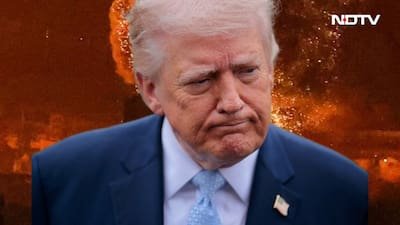
Source NDTV
WASHINGTON — U.S. President Donald Trump delivered an extraordinarily blunt warning to Tehran, declaring that Washington will “beat the fing s out of them” following an attempted surprise ballistic missile attack directed at American forces deployed in the Middle East.
The fiery remarks came during a phone interview with Fox News following reports from U.S. Central Command (CENTCOM) confirming that air defense systems had successfully intercepted a salvo of Iranian ballistic missiles fired late Tuesday night. The attack, which U.S. officials say targeted an American installation in Jordan—specifically Muwaffaq Salti Air Base—gave personnel only a few minutes of warning before anti-missile batteries engaged.
“A Very Hard Beating”
Speaking to reporters and media networks on Wednesday morning, Trump described watching video footage of U.S. service members tracking and destroying the incoming Iranian projectiles in real-time.
“We’re going to beat the fing s out of them,” Trump stated during the exchange. “We’ll be hitting them hard. They’re going to get a beating.”
He commended military personnel on the ground for their swift defense, emphasizing that non-combatant status and base integrity remained intact during the engagement: “None of this incoming Iranian fire got through.”
According to CENTCOM statements, the Islamic Revolutionary Guard Corps (IRGC) initiated the launch from Iranian territory without prior warning. U.S. multi-layered air defense batteries intercepted all incoming tracks prior to impact.
Escalation Following Coordinated Strikes
The missile engagement and subsequent rhetoric follow weeks of heightened hostility in the region. U.S. forces, acting alongside Saudi Arabian military assets, recently conducted a series of heavy airstrikes against Iranian-backed militia logistics centers and weaponry depots in eastern Iraq. Those strikes were launched after dozens of aerial drone attacks targeted coalition facilities over a 72-hour period.
Referencing those militia groups during his interview, Trump labeled the proxy networks a “cancer on the world” and confirmed that the joint operations had been coordinated with Iraqi authorities.
The latest back-and-forth threatens to derail what fragile diplomatic progress had been made through intermediary nations. Despite the sharp escalation in rhetoric, Trump signaled that Washington would not immediately close off third-party communications.
“We’re going to let them keep talking,” Trump remarked, referring to indirect negotiations focused on securing freedom of navigation in the Strait of Hormuz and addressing nuclear security concerns.
Defense Stocks and Force Readiness
The Pentagons’ military posture across the region remains on elevated alert as commanders anticipate potential follow-up actions by either state forces or regional proxy networks.
Metric / DetailStatus / Record
Primary TargetU.S. Air Base / Regional Assets (Jordan)
Interception Rate100% (CENTCOM Confirmed)
Coalition Partners InvolvedUnited States, Saudi Arabia
Diplomatic StatusActive Indirect Channels
While Capitol Hill lawmakers remain divided over the broader strategy and the risks of prolonged conflict, defense officials maintain that current force allocations in the Middle East are fully equipped to manage further escalation if additional strike orders are issued.









